Page Contents
The short answer
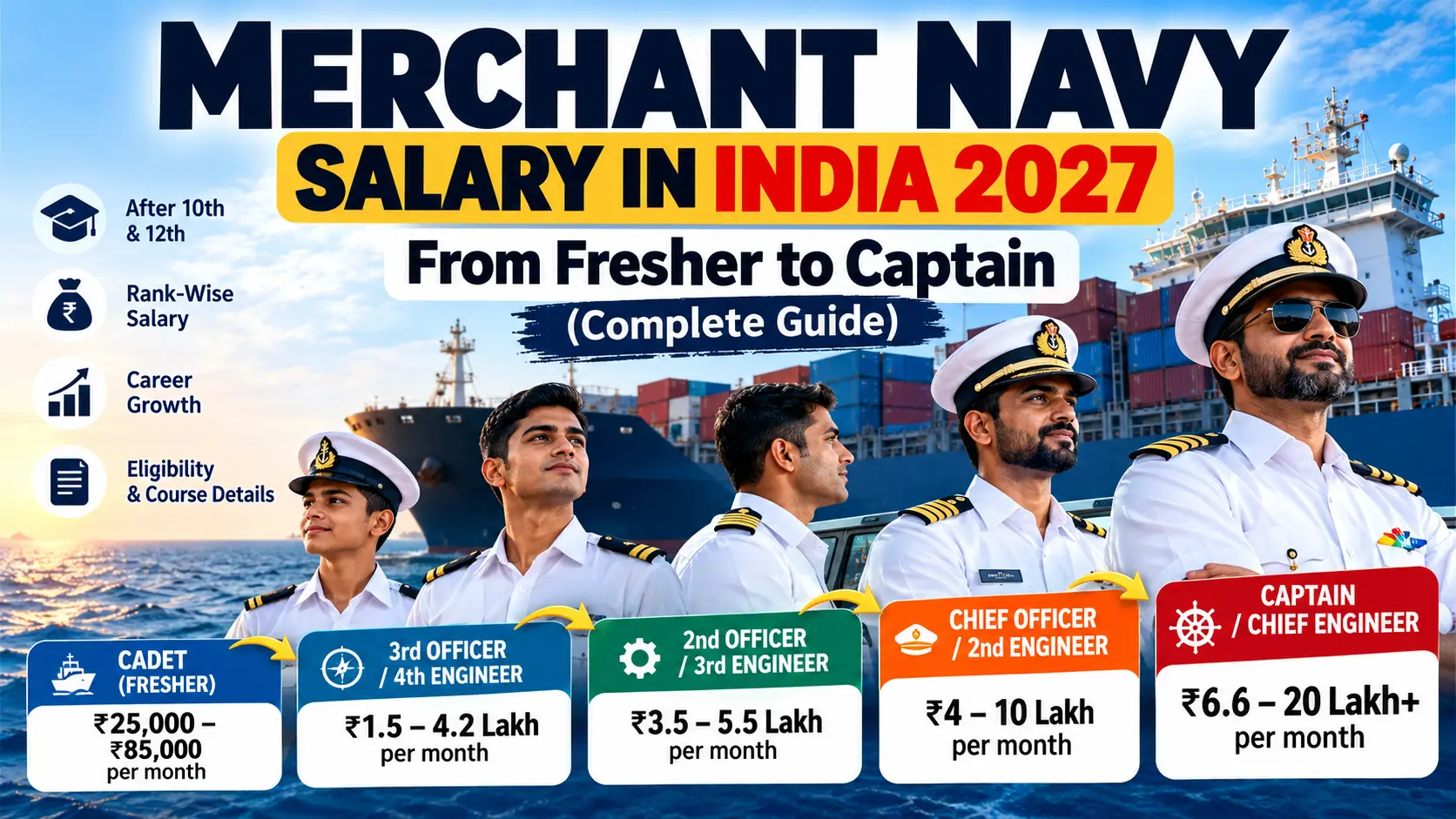
In 2027, a Merchant Navy cadet in India typically earns about Rs 25,000 to Rs 85,000 a month. A Chief Officer usually earns about Rs 4 lakh to Rs 10 lakh a month, and a Captain or Chief Engineer on senior contracts can earn Rs 6.6 lakh to Rs 20 lakh a month or more.
Pay depends mostly on rank, vessel type, employer and contract length. Treat every figure here as an indicative range, not a promise.
Merchant Navy salary at a glance
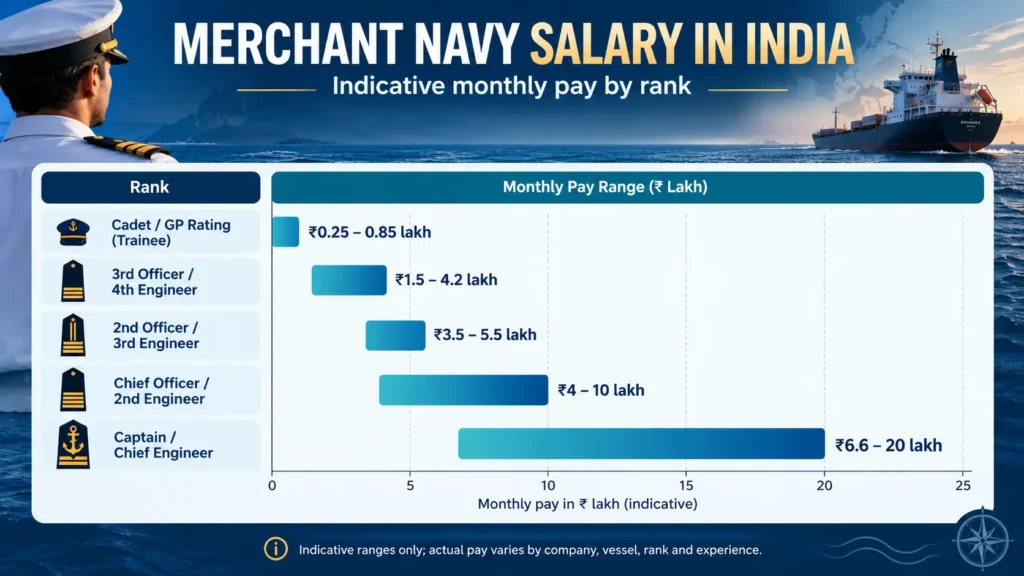
| Rank | Typical monthly pay (Rs) | What usually drives the number |
|---|---|---|
Deck or engine cadet (trainee) |
25,000 to 85,000 |
Company, stipend structure, training stage |
3rd Officer / 4th Engineer |
1,50,000 to 4,20,000 |
First officer-level post, vessel type |
2nd Officer / 3rd Engineer |
3,50,000 to 5,50,000 |
Sea service, certificate of competency |
Chief Officer / 2nd Engineer |
4,00,000 to 10,00,000 |
Cargo or engine responsibility, tanker or LNG work |
Captain / Chief Engineer |
6,60,000 to 20,00,000+ |
Command or top engine post, specialised vessels |
Figure 1. Indicative monthly pay bands by rank
Why Merchant Navy pay looks so high
The headline figures can look unusual next to a typical office job, so it helps to understand the structure behind them. Four things explain most of the gap.
- Living costs are often covered on board. Food and accommodation are usually part of the job, so a larger share of the pay can be saved.
- Contracts are time-bound. Seafarers typically work a set number of months on board, followed by leave. Pay is earned during that rotation, not across the whole year.
- Foreign-going work can be paid in foreign currency. Many international contracts are paid in US dollars or similar currencies, which changes the take-home value.
- Responsibility rises quickly. Officers command safety, cargo, navigation and crew welfare, and pay reflects that accountability.
Merchant Navy salary after 10th
A 10th pass student can enter the sector in limited roles, but the route into officer ranks almost always runs through science study at 12th level and approved pre-sea training. Entry rules are set by the Directorate General of Shipping, so check the current requirements before you enrol in any course.
Early pay for entry-level crew is usually at the lower end of the cadet and rating band, Rs 25,000 to Rs 60,000 a month in most reports. Progress depends on certificates and sea time, not just on how long you have worked.
Merchant Navy salary after 12th
The most common route is after 12th with Physics, Chemistry and Mathematics. Students then join pre-sea training as a deck cadet (navigation and ship operations) or an engine cadet (machinery and marine engineering). Some training institutes pay a stipend during the course, often reported around Rs 15,000 to Rs 25,000 a month, though this varies a lot by institute.
Training is not free. Course fees reported in 2026 guides often sit between Rs 2 lakh and Rs 6 lakh, depending on the institute and the programme. Compare the total cost with the stipend, the placement support and the reputation of the college before you commit.
Fresher salary in the Merchant Navy
A fresher usually starts as a cadet, and cadet pay is the least rewarding part of the career. The real earnings gap appears once you pass your exams and qualify as an officer. Most sources put the cadet band at about Rs 25,000 to Rs 85,000 a month, with the upper end typically reserved for trainees on larger international fleets.
A practical way to think about it: treat the cadet years as a paid apprenticeship with a clear promotion path. Your decisions in those years, such as which exams you clear and how quickly you accumulate sea time, shape your pay for the next decade.
Fresher salary in the Merchant Navy
Third Officer and Fourth Engineer
Once you qualify as a third officer on deck, or a fourth engineer in the engine department, your monthly pay moves into the lakh range. Reported figures run from about Rs 1.5 lakh to Rs 4.2 lakh a month, depending on vessel type and employer.
Second Officer and Third Engineer
Second officers and third engineers handle more specialised duties, such as navigation planning or machinery maintenance, and are paid accordingly. Common reported ranges are Rs 3.5 lakh to Rs 5.5 lakh a month.
Chief Officer and Second Engineer
The Chief Officer is the vessel’s senior deck officer after the Captain. The chief officer oversees cargo operations, deck crew, safety drills, environmental compliance and vessel security. The Second Engineer holds the matching senior role in the engine room. Typical reported pay is Rs 4 lakh to Rs 10 lakh a month.
Captain salary in the Merchant Navy
The Captain, also called the Master, holds ultimate legal and operational responsibility for the ship, its cargo and everyone on board. That responsibility is reflected in the pay band, which typically runs from about Rs 6.6 lakh to Rs 20 lakh a month on senior contracts.
- Entry to command: Most masters reach command after years as a Chief Officer and after passing the required competency exams.
- Highest pay: The upper end of the band is most often reported for senior masters on large oil tankers, LNG carriers and specialised offshore work.
- Lower end: Smaller vessels, coastal operations and some Indian-flag contracts usually pay less than the top foreign-going rates.
Chief Engineer salary in the Merchant Navy
The Chief Engineer leads the engine department and is responsible for propulsion, power generation, safety systems and planned maintenance. Reported pay for this rank is similar to the Captain band, roughly Rs 6.6 lakh to Rs 20 lakh a month, with the same premium on specialised ships.
Engineers who want to reach the top post typically work through Fourth, Third and Second Engineer ranks, then sit the required certificates. The career is demanding, but the pay progression is clear and well documented.
Indian companies or foreign companies: which pays more?
In general, foreign-going contracts with international shipping lines pay more than work on Indian coastal or domestic vessels. The difference comes from the type of trade, the currency of the contract and the competitiveness of global crew markets.
| Factor | Indian coastal or domestic | Foreign-going or international |
|---|---|---|
Typical pay level |
Lower to middle range |
Middle to top of the range |
Currency |
Usually rupees |
Often dollars or other foreign currency |
Work pattern |
Shorter trips, closer to home |
Longer voyages and rotations abroad |
Tax treatment |
Taxed as normal Indian income |
May qualify for NRI treatment (see below) |
Is Merchant Navy salary tax-free in India?
Many people believe Merchant Navy income is fully tax-free. The reality is more specific. Income earned by a seafarer can be treated differently depending on residency status for the financial year, which is usually decided by how many days the person spends outside India.
- The 182-day test: A person who spends 182 days or more outside India in a financial year may be treated as a non-resident for that year. Non-resident income earned outside India is generally not taxable in India.
- Seafarer days: Time spent on a foreign-going ship is often counted in these calculations, but the exact treatment depends on the voyage and the rules in force for that year.
- Check the rules for your case: Tax treatment depends on your own days, employer and income. Speak with a qualified chartered accountant before you assume anything.
Is a Merchant Navy career worth it?
It depends on what you want from work. The career suits people who are comfortable with long periods away from home and who value steady, high income over a conventional daily routine.
The strengths
- Pay rises sharply after the early officer ranks.
- Living costs on board are often covered, which helps savings.
- Skills are recognised internationally and transfer across countries.
- Clear promotion path based on exams and sea time.
The trade-offs
- Long months away from family, with limited connectivity on some voyages.
- Physically and mentally demanding work, with safety responsibilities.
- Upfront training costs and exam fees before you earn officer pay.
- Pay can fall during periods without a contract or during downturns in shipping.
How to start a Merchant Navy career: five steps
- Check your eligibility. Confirm the current education and medical requirements with the Directorate General of Shipping and a recognised training institute.
- Choose a path. Decide between deck, engine or a support role, based on your interests and academic background.
- Compare training institutes. Look at total cost, stipends, placement support, inspection record and pass rates.
- Complete pre-sea training and certificates. Sit the required exams, complete your cadet training and build sea time.
- Plan your progression. Track your certificates, sea service and promotion timeline so you know when your pay should step up.
Before choosing your maritime career path, understand the IMU CET syllabus, eligibility requirements, and admission process. You can also explore IMUCET coaching in Kerala for additional preparation guidance.
Frequently Asked Questions
Most cadets are reported to earn about Rs 25,000 to Rs 85,000 a month. Pay varies by company, vessel and training stage.
Reported figures for senior Captains usually fall between Rs 6.6 lakh and Rs 20 lakh a month. Lower ranges apply to smaller or domestic vessels.
The Chief Engineer band is similar to the Captain band, typically Rs 6.6 lakh to Rs 20 lakh a month on senior contracts.
Some entry-level roles exist after 10th, but officer careers usually need a 12th pass in science and approved training. Check current requirements with the Directorate General of Shipping.
For more insights read the blog : https://naututor.com/how-to-join-merchant-navy-after-12th/
It can be, for seafarers who qualify as non-residents in a given financial year. The 182-day rule is the usual starting point. Get personalised advice from a chartered accountant.
Many seafarers work for decades, but others move ashore into training, maritime management, surveying or port roles. Your options depend on your certificates and experience.

Rahil T P
3rd Officer | Founder | Senior Mentor
Rahil T P is the Founder and Senior Mentor at Naututor Academy and a Third Officer with Synergy Marine. He reviews nautical science educational content to support clear and practical learning for aspiring maritime professionals.