Page Contents
What is Squat? - Explanation of Squat effect and Shallow Water
Extra Knowledge In Nautical Science
Tips: We sorted important topics below, it will help you out in exams. good luck Before proceeding to squat we have to know what is shallow water,
Before proceeding to squat we have to know what is shallow water,
What Is Shallow Water?
Shallow water is water whose depth is relatively small compared with a vessel’s draft. When a ship moves through water with limited depth or room around it, the flow of water around the hull can be affected more strongly.
A depth of less than about 1.5 times the vessel’s deepest draft is sometimes used as a preliminary indication of shallow-water conditions. However, this is only a rule of thumb, not a universal definition. The actual effect depends on the vessel, water depth, channel shape, speed and available under-keel clearance.
What Is the Squat Effect in Ships? Explanation of Squat effect at sea
- A ship proceeding through water pushes water ahead of her. This creates a void space immediately behind the vessel, which is gradually filled up with water from all around in the vicinity, water rolling down underneath the bottom and that flowing along the sides of the vessel. The process continues as long as the ship is making way through the water.
- In open seas, the effect does not necessarily cause great concern.
- In congested and shallow waters, the effect is predominant*, the reason being unavailability of sufficient water near the aft extremity of the vessel, to fill up the void. And hence this requires due attention and control measures to avoid any damages or accidents.
- The occurrence of squat is based on Bernoulli’s theorem.
So you understood the introduction to squat effect. This is one of the important concepts for students preparing for maritime entrance examinations. If you are preparing for IMU-CET and looking for structured preparation, explore our IMU CET Coaching in Kerala program for expert guidance and comprehensive study support.
How Does Squat Occur?
- The vessel moves forward and displaces the surrounding water.
- Water flows around and beneath the hull, and its movement is influenced by the vessel’s speed and the available space.
- The flow creates changes in pressure around the hull.
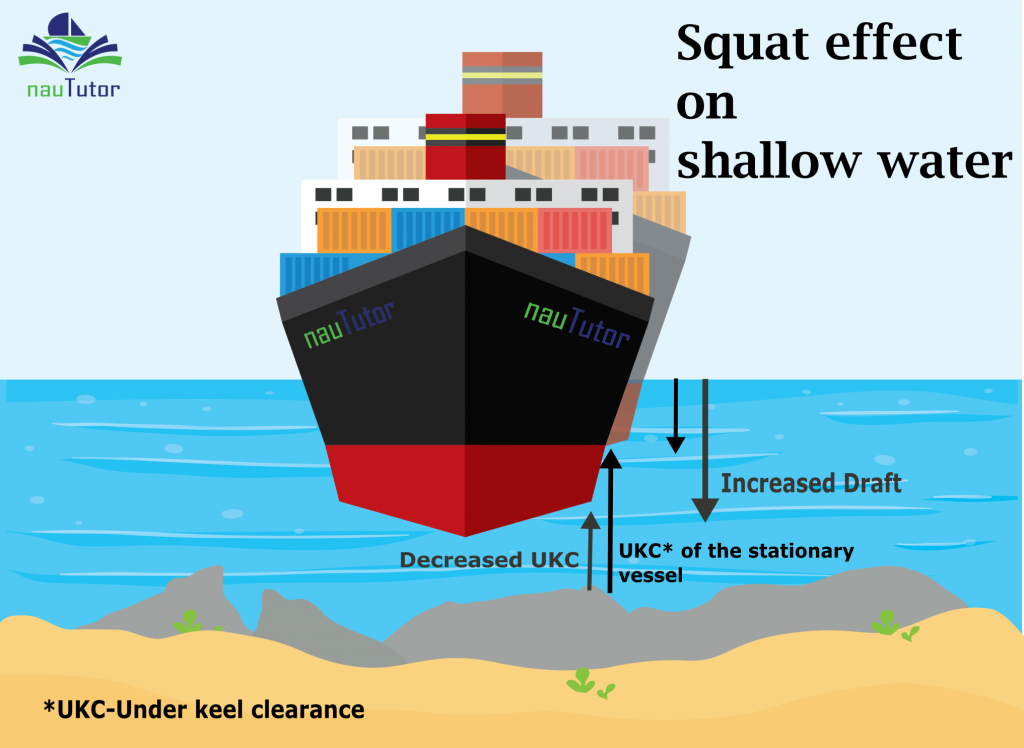
- Hydrodynamic forces cause the vessel to sink relative to the surrounding water level and may change its trim.
- The distance between the keel and the seabed becomes smaller, reducing under-keel clearance.
- Squat is associated with Bernoulli’s principle, which describes the relationship between fluid velocity and pressure under suitable flow conditions. However, squat is a complex hydrodynamic effect and cannot be explained by Bernoulli’s principle alone.
What Is Under-Keel Clearance (UKC)?
Under-keel clearance is the vertical distance between the lowest point of a vessel’s keel and the seabed. It is a key safety consideration when navigating in shallow water.
- The available clearance can be affected by:
- The vessel’s draft and loading condition.
- The actual water depth and changes in tide or water level.
- The squat effect at the vessel’s current speed.
- Wave-induced motions and other environmental conditions.
- Seabed characteristics and the vessel’s operating circumstances.
When planning a passage, the bridge team should account for expected squat and follow the vessel’s approved under-keel-clearance policy and relevant local requirements.
Factors That Affect the Squat Effect
1. Ship speed
Speed is one of the most important factors affecting squat. Under comparable conditions, squat generally increases approximately with the square of speed. As a result, even a modest increase in speed can cause a significant increase in squat.
2. Water depth
Squat can become more significant when the available depth is limited in relation to the vessel’s draft. Restricted water flow around the hull can increase the hydrodynamic effects.
3. Channel width
A narrow channel gives water less room to flow around the vessel. This can increase the blockage effect and make squat more pronounced than in unrestricted water, depending on the vessel and channel geometry.
4. Block coefficient (Cb)
The block coefficient describes how full or box-shaped a vessel’s underwater hull is. It is the ratio of the vessel’s underwater volume to the volume of a rectangular block with the same length, breadth and draft. It is used in some simplified squat-estimation methods.
5. Draft and loading condition
The vessel’s draft and loading condition affect both the available under-keel clearance and the water flow around the hull. Squat and trim may differ between ballast and loaded conditions.
6. Hull shape
A vessel’s hull dimensions and shape influence the flow around it and therefore affect its squat response.
Effects of Squat on Ship Navigation
- Reduced under-keel clearance: the vessel moves closer to the seabed.
- Greater grounding risk: insufficient clearance may cause the keel to touch the seabed.
- Change in trim: the bow or stern may sink more, depending on the vessel and operating conditions.
- Changes in manoeuvring behaviour: the vessel’s handling characteristics may be affected.
- Increased risk in restricted waters: shallow channels and confined waterways require particular attention.
Squat should therefore be considered during passage planning and while navigating through shallow or restricted waters.
Squat Calculation
Squat can be estimated using simplified empirical formulas. A commonly taught approximation associated with the Barrass method is shown below:
Simplified estimate for open water
Squat (m) = (Cb × V²) / 100
Simplified estimate for shallow or confined water
Squat (m) = (Cb × V²) / 50
Where:
- Cb = block coefficient of the vessel
- V = vessel speed in knots
- Squat = estimated squat in metres
These are simplified estimates, not universal formulas for every vessel or waterway. Actual squat depends on vessel characteristics, water depth, channel geometry and operating conditions. For operational navigation, consult the vessel’s manoeuvring booklet, approved guidance and applicable bridge procedures.
Worked Example: Squat Calculation
Suppose a vessel has a block coefficient of 0.75 and is travelling at 10 knots.
Step 1: Estimate squat in open water
Squat = (Cb × V²) / 100
Squat = (0.75 × 10²) / 100
Squat = 75 / 100 = 0.75 metres
Step 2: Estimate squat in shallow or confined water
Squat = (Cb × V²) / 50
Squat = (0.75 × 10²) / 50
Squat = 75 / 50 = 1.5 metres
In this simplified example, the estimated squat is 0.75 m in open water and 1.5 m in shallow or confined water. These figures are illustrative only. Navigators must use vessel-specific information and the correct method for actual conditions.
How Can the Squat Effect Be Managed?
- Maintain an appropriate speed. Reducing speed can significantly reduce squat under comparable conditions.
- Monitor under-keel clearance by considering water depth, draft, tide and expected squat.
- Follow passage-planning procedures and the vessel’s approved UKC policy.
- Consider channel restrictions, including water depth, width and traffic.
- Reassess conditions when speed, loading, tide or the navigational situation changes.
- Follow bridge-team procedures and local navigation instructions.
The correct action depends on the vessel, waterway and situation. Always comply with the vessel’s procedures and applicable navigation requirements.
Important Exam Points About Squat
- Squat is the hydrodynamic sinking of a moving vessel relative to the surrounding water level; it may also change the vessel’s trim.
- Squat reduces under-keel clearance.
- Squat generally increases with vessel speed.
- Shallow water and restricted channels can make squat more pronounced.
- Cb represents the block coefficient.
- V represents the vessel’s speed in knots in the simplified formulas used in this article.
- Squat may cause both sinkage and trim changes.
- For real navigation, use vessel-specific guidance rather than relying only on a simplified formula.
Conclusion
The squat effect is an important consideration in ship navigation, especially in shallow water and restricted channels. It can reduce under-keel clearance, affect trim and increase the risk of grounding. Understanding what squat is, the factors that influence it and how it is estimated gives maritime students a useful foundation in nautical science. For operational decisions, always follow approved vessel-specific guidance and safe navigation procedures.
Frequently Asked Questions About Squat Effect in Ship
The squat effect is a hydrodynamic phenomenon in which a moving ship sinks relative to the surrounding water level and may change trim. This reduces under-keel clearance.
In shallow water, the flow around and beneath a moving vessel is more restricted. Changes in water velocity and pressure can therefore make the squat effect more significant.
A commonly taught simplified estimate is Squat (m) = (Cb × V²) / 100, where Cb is the block coefficient and V is speed in knots. It is an approximation and must be used only when appropriate.
A simplified approximation commonly taught is Squat (m) = (Cb × V²) / 50. The actual value depends on the vessel and waterway, so vessel-specific guidance should be followed.
Under comparable conditions, squat generally increases approximately with the square of speed. Increasing speed can therefore reduce under-keel clearance significantly.
The block coefficient (Cb) describes the fullness of the vessel’s underwater hull. It is used in simplified empirical methods to estimate squat.
Under-keel clearance is the vertical distance between the lowest point of the vessel’s keel and the seabed. Squat reduces this clearance.
A ship can manage squat by maintaining an appropriate speed, monitoring under-keel clearance, following passage-planning procedures and considering the depth and width of the channel.
It can be. Restricted channels may limit water flow around a vessel and increase squat, although the actual effect depends on the channel and vessel characteristics.
Squat connects ship movement, shallow-water navigation, under-keel clearance and navigational safety. Understanding its causes and estimation methods helps students build their nautical science knowledge.

Rahil T P
3rd Officer | Founder | Senior Mentor
Rahil T P is the Founder and Senior Mentor at Naututor Academy and a Third Officer with Synergy Marine. He reviews nautical science educational content to support clear and practical learning for aspiring maritime professionals.