Every year, thousands of Class 12 students look at a life stuck between a desk and a daily commute and think: there has to be something bigger. If you’ve ever pictured yourself on the deck of a ship crossing the Pacific, or in the engine room of a vessel keeping a 300-metre-long ship running, the Merchant Navy is a genuinely realistic career to chase not just a dream reserved for a lucky few.
The catch is that almost nobody explains the actual process clearly. Which course should you pick? What if you’re not from a science background? Which exam do you actually need? Is DG Shipping still called that? This guide answers all of it in one place, in plain language, based on how the process works right nownot how it worked five years ago.
Quick update: India’s maritime regulator, formerly the Directorate General of Shipping (DGS), was officially renamed the Directorate General of Maritime Administration (DGMA) in 2026 under the Merchant Shipping Act, 2025. It’s the same authority, same approvals, new name — you’ll see both names used interchangeably online for a while, and both refer to the same body.
Page Contents
What Is the Merchant Navy, Exactly?
The Merchant Navy is the commercial shipping industry, the fleet of cargo ships, oil tankers, container vessels and passenger ships that move roughly 90% of world trade. It’s not a defence force, and it’s not a government job in the way the Indian Navy is. You’d be employed by private or international shipping companies, while the entire industry is regulated for safety, training and certification by DGMA (Government of India), operating under international rules set by the IMO (International Maritime Organization).
Two departments run every ship, and after Class 12 you pick one:
- Deck Department — navigation, cargo operations, and the overall safety and command of the ship. This path leads toward Third Officer → Second Officer → Chief Officer → Captain.
- Engine Department — the technical side: engines, generators, electrical and mechanical systems. This path leads toward Fourth Engineer → Third Engineer → Second Engineer → Chief Engineer.
Eligibility Criteria for Merchant Navy After 12th
| Criteria | Requirement |
|---|---|
Academics |
Class 12 pass with Physics, Chemistry and Mathematics (PCM); most institutes ask for a minimum of 50–60% aggregate in PCM |
English |
Minimum 50% in English, in either Class 10 or Class 12 |
Age |
Generally 17 to 25 years, varying slightly by course and institute |
Medical fitness |
6/6 unaided vision in the better eye, no colour blindness, fit for sea service as per DGMA medical standards |
Non-PCM students |
Not disqualified — the GP Rating route (see below) is open to any stream, even after Class 10 |
A detail students often miss: not having PCM doesn’t shut the door. It only rules out the officer-level degree courses. There’s still a legitimate, well-paying route in the GP Rating course which we’ve covered below.
Your Career Roadmap After 12th
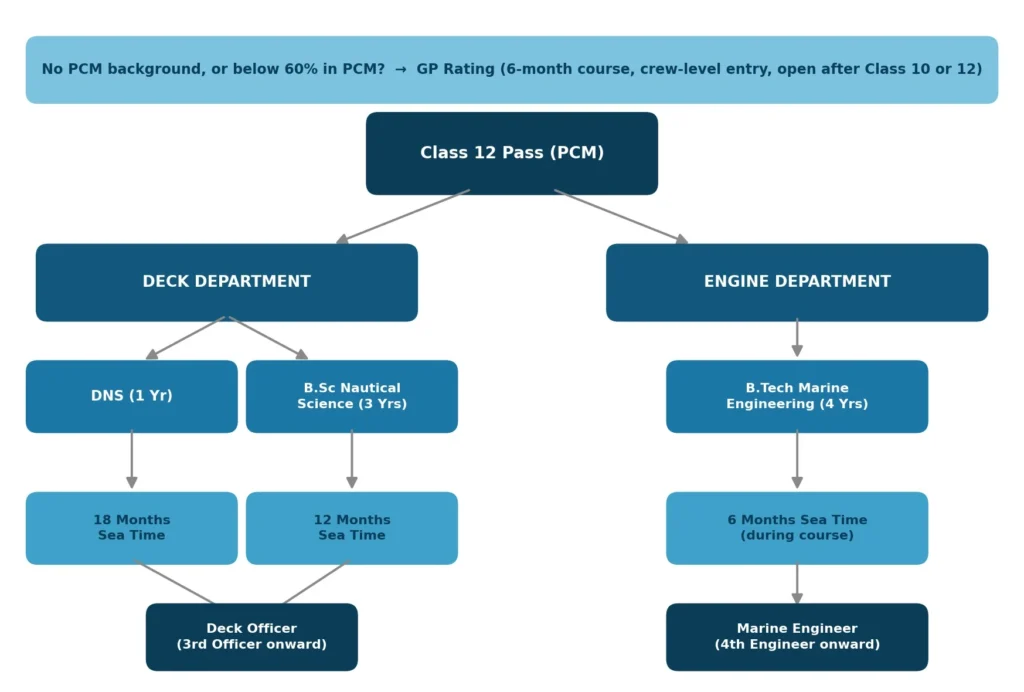
Deck and Engine pathways both start the same way at Class 12 with PCM and diverge from there.
Step-by-Step Process to Join the Merchant Navy After 12th
Step 1: Finish Class 12 with the Right Subjects
Complete your 10+2 with Physics, Chemistry and Mathematics. If you’re set on the officer track, keep your PCM aggregate above 60% where possible — several top institutes use it as a cut-off, not just a minimum.
Step 2: Decide: Deck, Engine, or GP Rating
Deck suits people who enjoy navigation, ship-handling and eventually commanding a vessel. Engine suits those who like machinery and hands-on technical problem-solving. If PCM isn’t your background, or you want the fastest, most affordable entry into the industry, GP Rating is a genuine third option — a 6-month course open after Class 10 or 12 in any stream.
Step 3: Clear the Entrance Exam
IMU CET (Indian Maritime University Common Entrance Test) is the main gateway for DNS, B.Sc Nautical Science and B.Tech Marine Engineering, and is mandatory for IMU’s own campuses and most affiliated institutes. Some private institutes also accept AIMNET or run their own company-sponsored selection tests, so check what your target institute requires before you commit your prep time.
Step 4: Pass the Medical Examination
This has to be done by a DGMA-approved doctor, and it’s non-negotiable — colour blindness or eyesight below the required standard can end your eligibility regardless of your rank or marks, so get an early check-up before you invest a year of preparation.
Step 5: Get Into a DGMA-Approved, IMU-Affiliated Institute
Approval status is the single most important thing to verify before you enrol anywhere. An unapproved institute’s certificate won’t get you a CDC (Continuous Discharge Certificate) or a berth on a ship, no matter how good the campus looks in the brochure.
Step 6: Complete Pre-Sea Training and Certifications
Alongside academics, you’ll earn your STCW (Standards of Training, Certification and Watchkeeping) certificates — mandatory international qualifications covering safety, firefighting, survival and first aid at sea.
Step 7: Go to Sea as a Cadet
Your first placement is as a Deck Cadet or Engine Cadet, sailing under senior officers to complete your mandatory sea time. This is where the classroom training turns into the real job.
Step 8: Clear Competency Exams and Get Promoted
After sea time, you’ll sit for the relevant competency exam (2nd Mate for Deck, for instance) to move up. Progress continues with more sea time and exams: Third Officer → Second Officer → Chief Officer → Captain on the Deck side, or Fourth Engineer → Third Engineer → Second Engineer → Chief Engineer on the Engine side.
Merchant Navy Courses After 12th, Compared
| Course | Duration | Department | Eligibility | Leads To |
|---|---|---|---|---|
GP Rating |
6 months |
Deck or Engine (crew) |
Class 10 or 12, any stream, 40%+ in English |
Crew-level roles; can rise to officer with sea time and exams |
DNS (Diploma in Nautical Science) |
1 year + 18 months sea time |
Deck |
12th PCM, 60% aggregate |
B.Sc Nautical Science + Deck Officer track |
B.Sc Nautical Science |
3 years + 12 months sea time |
Deck |
12th PCM, 60% aggregate |
Deck Officer track |
B.Tech Marine Engineering |
4 years |
Engine |
12th PCM, 60% aggregate |
Marine Engineer track |
A quick, honest note on GP Rating: it isn’t a lesser path it’s simply a different one. It gets you to sea faster and at a lower cost, and with consistent sea service and further exams, ratings do move up to officer level over time. If PCM or a 3–4 year degree isn’t realistic for you right now, this is not a dead end.
Entrance Exams You Should Know About
- IMU CET — the primary exam for IMU’s own campuses and most affiliated colleges; covers Mathematics, Physics, Chemistry, English and General Aptitude/Knowledge.
- AIMNET (All India Merchant Navy Entrance Test) — accepted by a number of private maritime institutes as an alternative to IMU CET.
- Company-sponsored selection tests — some shipping companies (Anglo-Eastern, Great Eastern, and others) run their own written tests and interviews and directly sponsor selected cadets, sometimes bundling training costs into the sponsorship.
Top Institutes to Consider
- Indian Maritime University (IMU) campuses — Chennai, Mumbai, Kolkata, Kochi, Visakhapatnam — offering B.Tech Marine Engineering, B.Tech Naval Architecture & Ocean Engineering, B.Sc Nautical Science, DNS and more.
- Tolani Maritime Institute, Pune — known for strong infrastructure and consistent placement records across DNS, B.Sc Nautical Science and B.Tech Marine Engineering.
Whichever institute you shortlist, verify two things directly on the DGMA and IMU websites before paying any fee: current DGMA approval, and IMU affiliation for the specific course you’re applying to.
What Can You Expect to Earn?
Salaries scale quickly with rank and sea experience, and international voyages generally pay more than coastal ones. Here’s a realistic, rank-wise picture:
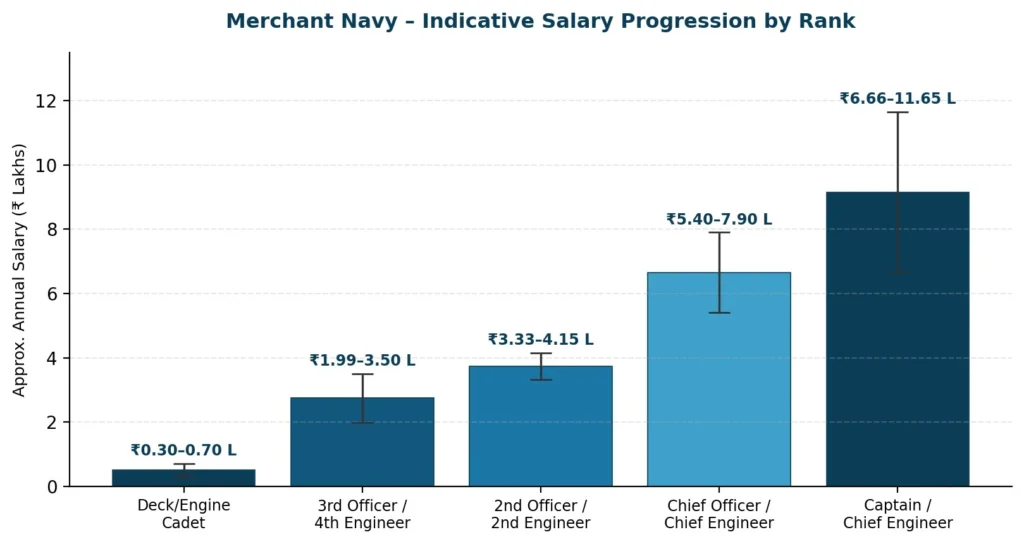
Pay typically multiplies several times over between your first contract as a cadet and command rank.
| Rank | Approx. Monthly Salary (₹) |
|---|---|
Deck / Engine Cadet |
30,000 – 70,000 |
3rd Officer / 4th Engineer |
1,99,000 – 3,50,000 |
2nd Officer / 2nd Engineer |
3,33,000 – 4,15,000 |
Chief Officer / Chief Engineer |
5,40,000 – 7,90,000 |
Captain / Chief Engineer (senior) |
6,66,000 – 11,65,000 |
Figures vary by shipping company, vessel type and route, so treat these as an indicative range rather than a guarantee but the trajectory is consistent: income rises sharply with every rank and every year of sea experience.
Mistakes to Avoid
- Skipping the DGMA-approval check before enrolling — this single oversight can waste years of effort if the institute or course isn’t recognised.
- Ignoring eyesight or colour-blindness issues until after a course is paid for — get a medical check done early.
- Assuming a non-PCM background rules you out entirely — GP Rating remains open regardless of stream.
- Choosing an institute purely on advertising or campus photos instead of checking its actual placement record and DGMA/IMU status.
- Underestimating English and General Knowledge preparation for IMU CET — these sections are easier to score consistently than Physics or Maths.
Prepare for IMU-CET with Expert Guidance with Real Sailors
Are you planning to join the Merchant Navy after 12th through courses such as B.Sc. Nautical Science or DNS, proper IMU-CET preparation can help you build a strong foundation in Physics, Chemistry and Mathematics. Students looking for IMU CET coaching in Kerala can consider structured coaching with mock tests , regular assessments, study materials and expert guidance.
Frequently Asked Questions
Not for the officer-level degree courses, which require PCM. But you can still join through the GP Rating course, which is open to any stream after Class 10 or 12, and can lead to officer rank later with sea service and exams.
No. It’s a civilian, private-sector career, though the entire industry training, certification, safety standards is regulated by DGMA (formerly DG Shipping), Government of India.
IMU CET is the main entrance exam for DNS, B.Sc Nautical Science and B.Tech Marine Engineering at IMU campuses and most affiliated colleges. Some private institutes also accept AIMNET or hold their own company-sponsored tests.
IMU CET is the main entrance exam for DNS, B.Sc Nautical Science and B.Tech Marine Engineering at IMU campuses and most affiliated colleges. Some private institutes also accept AIMNET or hold their own company-sponsored tests.
Most institutes ask for a minimum of 50–60% aggregate in PCM, along with at least 50% in English in Class 10 or 12. Exact cut-offs vary by institute and course, so always check the current prospectus.
The authority itself hasn’t changed only its name has. DG Shipping was officially renamed the Directorate General of Maritime Administration (DGMA) in 2026 under the Merchant Shipping Act, 2025. Any approval that mentioned ‘DG Shipping approved’ still applies under DGMA.
GP Rating (General Purpose Rating) is a 6-month, DGMA-approved pre-sea course open after Class 10 or 12 in any stream. It’s a genuinely good option if you want the fastest, most affordable entry into the industry or don’t have a PCM background — ratings can work their way up to officer level with sea service and further exams.
Most cadets join a shipping company as a Deck or Engine Cadet within 6–12 months of completing their course and certification, assuming the institute has active placement support.
Pay at equivalent ranks is broadly similar on both sides. The bigger factor is company, vessel type and route rather than department, so choose based on which work genuinely interests you rather than a marginal salary difference.
It isn’t always a strict entry requirement, but you’ll be trained and tested on water safety and survival skills during pre-sea training regardless, so it’s worth learning beforehand.
Yes. Merchant Navy jobs can be physically and mentally demanding due to long working hours, strict routines, and extended periods at sea.
Merchant Navy course fees vary by course and institute, typically ranging from around ₹2 lakh to ₹8 lakh or more.
Yes, there are other entry routes into the Indian Navy after 12th, depending on your qualification and eligibility.
The difficulty depends on the exam and your preparation. Strong preparation in mathematics, physics, English, and reasoning can help.
Yes. Women can join the Indian Navy through eligible entry schemes and serve in various roles.
The required marks depend on the specific Navy examination, category, and recruitment notification.
The Indian Navy and Army offer different career paths, roles, and working environments. Your choice should depend on your interests and eligibility.
Yes. You can apply for Merchant Navy jobs through shipping companies, recruitment agencies, and official maritime employment portals.
People who do not meet the required educational, medical, age, eyesight, or other eligibility criteria may not be eligible.
Countries such as India, the Philippines, Greece, Singapore, and the UK have significant maritime industries. The best option depends on your course, nationality, qualifications, and career goals.
Merchant Navy salaries vary by rank and experience. A Deck or Engine Cadet may earn around ₹30,000–₹70,000 per month, while experienced senior officers such as Captains and Chief Engineers can earn approximately ₹6.66 lakh–₹11.65 lakh per month.