
If you’ve decided that a career at sea is what you want, the Indian Maritime University Common Entrance Test better known as IMU CET is the door you have to walk through first. It’s the single exam that decides whether you get into B.Tech Marine Engineering, B.Sc Nautical Science, DNS (Diploma in Nautical Science), or one of the other maritime programmes run by IMU and its affiliated colleges. And because so many students are chasing a limited number of seats, your rank matters just as much as clearing the exam.
This guide is written for anyone starting their IMU CET 2027 preparation, whether you’re a complete beginner or already halfway through your Class 12 syllabus and want a sharper, more organised plan for IMU CET preparation. We’ll walk through the exam pattern, syllabus, a month-by-month preparation roadmap, the mistakes that quietly cost students and their rank, we answers to the questions we get asked most often.
Page Contents
What Exactly Is IMU CET?
IMU CET is a national-level, computer-based entrance test conducted by the Indian Maritime University for admission to undergraduate, postgraduate and diploma maritime courses across its campuses in Chennai, Mumbai, Kolkata, Kochi and Visakhapatnam, along with several DG Shipping-approved affiliated institutes. For UG programmes, it’s a 3-hour, 200-question multiple-choice test built almost entirely on the Class 11 and 12 NCERT syllabus, so there’s very little you’ll need to learn that isn’t already part of your board exam preparation.
Exam Pattern: What You're Actually Up Against
Before you open a single book, it helps to know exactly how the paper is structured — it tells you where to put your hours
| Particular | Detail |
|---|---|
Mode |
Mode |
Duration |
3 hours (180 minutes) |
Total Questions |
200 (UG courses) |
Question Type |
Multiple Choice Questions |
Medium |
English |
English |
Varies by cycle — several recent years applied roughly a quarter-mark deduction for wrong answers. Confirm the exact scheme in the official 2027 notification before deciding your attempt strategy. |
Varies by cycle several recent years applied roughly a quarter-mark deduction for wrong answers. Confirm the exact scheme in the official 2027 notification before deciding your attempt strategy.
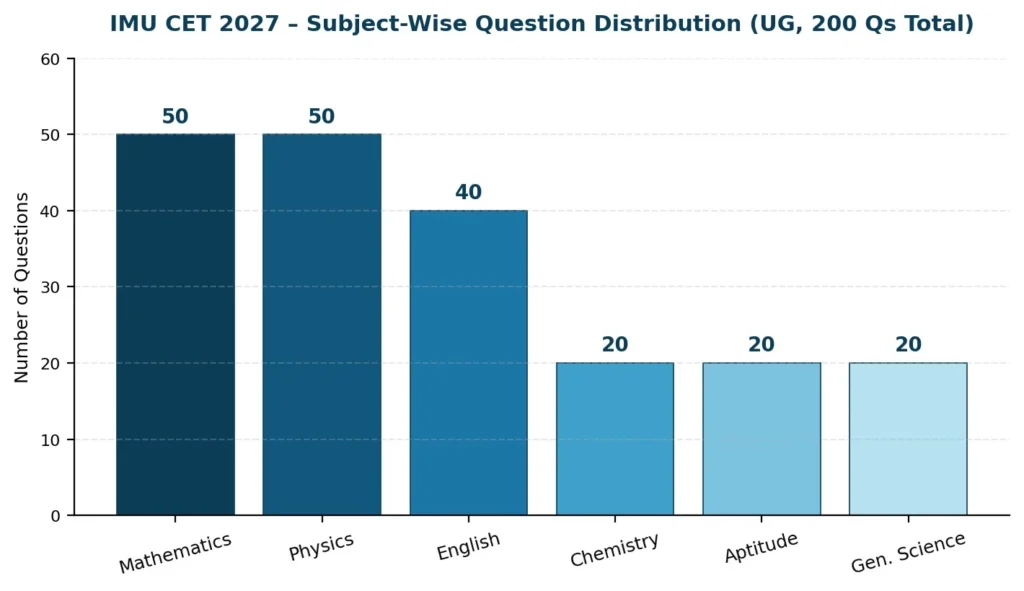
| Subject | Approx. Questions |
|---|---|
Mathematics |
50 |
Physics |
50 |
English |
20 |
Chemistry |
20 |
General Aptitude & Reasoning |
20 |
General Science / Knowledge |
20 |
Eligibility, Briefly
- Passed or appearing for Class 12 with Physics, Chemistry and Mathematics as compulsory subjects.
- A minimum aggregate in PCM is generally expected for technical courses (commonly around 60%, but this is set fresh each year).
- A minimum English score, usually in either Class 10 or Class 12.
- Age is typically between 17–25 for UG courses, with relaxation for reserved categories as per government norms.
- Medical fitness to maritime standards — this is checked after the CET, before final admission.
Because these numbers shift slightly each year, treat this as a working guide and confirm the exact figures once IMU releases the 2027 prospectus.
A Month-Wise Roadmap for IMU CET 2027
If you’re reading this in the second half of 2026, you likely have somewhere between six and ten months before the exam which is a comfortable amount of time if you use it deliberately instead of drifting through it.
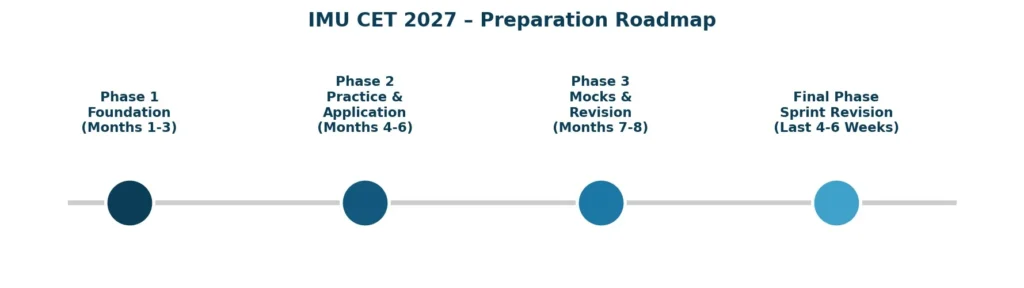
Phase 1 — Build the Foundation
- Go chapter by chapter through NCERT Physics, Chemistry and Maths for Classes 11 and 12. Don’t skip the ‘easy’ chapters — IMU CET draws from all of them.
- Solve basic problems as you finish each topic instead of reading theory for weeks before touching a question.
- Start light, daily English practice grammar rules and new vocabulary in short bursts work better than one long weekly session.
- Skim a general knowledge digest once a week, paying extra attention to shipping and maritime-related news — it’s a section most students under-prepare for.
Phase 2 — Shift to Practice
- Move from reading to solving: mixed problem sets, chapter-end tests, and previous years’ papers.
- Introduce one timed, subject-wise test every week to build speed alongside accuracy.
- Go back and fix the weak topics you flagged in Phase 1 — don’t let them ride into your mock-test phase.
- Ramp up aptitude and reasoning practice; it’s the section that improves fastest with repetition.
Phase 3 — Full Mocks and Targeted Revision
- Sit full-length, 3-hour mock tests under real exam conditions, not in bits and pieces.
- After each mock, don’t just check the score — log which questions you got wrong, why, and which topic they came from.
- Switch from learning new material to revising formula sheets and short notes.
- Be honest about balancing this with Class 12 boards — the syllabi overlap heavily, so smart revision covers both at once.
Final Phase — The Last 4 to 6 Weeks
- No new topics from this point. Revision only.
- Take two to three mock tests a week and review every single mistake, even the silly ones.
- Sleep, food and stress management matter here as much as study hours do — a tired brain forgets faster than it learns.
- Keep your documents (admit card, ID proof, photographs) ready well in advance so exam week has one less thing to worry about.
7 Common Mistakes to Avoid During IMU CET Preparation
- Starting late and trying to compress a two-year syllabus into eight or ten weeks.Treating English and General Knowledge as an afterthought they’re some of the easiest marks to pick up with consistent, low-effort practice.
- Avoiding mock tests until the last few weeks, which means you discover your time-management problems too late to fix them.
- Studying only your strong subjects because they feel more rewarding, while weak subjects quietly drag your overall rank down.
- Memorising formulas instead of understanding where they come from IMU CET increasingly frames questions around applied scenarios, not direct recall.
- Ignoring the marking scheme. If negative marking applies in your year, guessing blindly on questions you’re unsure of can hurt more than it helps.
Enrolling with a training institute before checking it’s DG Shipping approved this affects your eligibility for sea service later, not just your CET rank
Should You Self-Study or Join Coaching?
Honestly, either can work. If you already know what to study, have the discipline to stay consistent without anyone checking in on you, and enjoy solving problems on your own, self-study is entirely realistic plenty of students clear IMU CET this way. But if you know your consistency dips without external structure, or you want doubts cleared quickly instead of losing days stuck on one concept, a guided coaching programme especially for Physics and Mathematics can help shorten that learning curve. In Kerala, NauTutor, an award-winning IMU CET coaching centre, provides structured preparation, expert guidance, mock tests, and support for students who prefer a guided approach. The honest answer is to pick whichever option you’ll actually stick with for eight months, not the one that sounds more impressive.
Conclusion
Students who top the IMU CET merit list are rarely the ones who crammed for three months they’re the ones who treated it as a steady, eight-month process. Understand the pattern, build your concepts before chasing speed, revise on a schedule instead of by memory, and let mock tests tell you the truth about where you stand. Start now, stay consistent, and let your rank do the talking in May.
Frequently Asked Questions About IMU CET Preperation
It’s a moderate-difficulty, rank-based exam built on the Class 11–12 syllabus. It’s very manageable with a structured plan the difficulty most students face is inconsistency, not the exam content itself.
Ideally 8–10 months before the exam. If you’re still in Class 11 or early Class 12, you have enough runway to build real understanding instead of rushing through topics later.
For Physics, Chemistry and Maths, NCERT covers the core concepts well. Supplement it with previous years’ papers and timed mock tests to build speed NCERT alone won’t train your exam-day pace.
The marking scheme has varied across recent cycles. Always check the current year’s official notification before deciding how aggressively to attempt uncertain questions.
Yes. Female candidates are fully eligible, and shipping companies increasingly encourage women into maritime careers.
Mathematics and Physics carry the highest weightage and deserve the largest share of your study time, followed by English, Chemistry, Aptitude and General Knowledge.
Ideally, start preparing 8–10 months before the exam so you have enough time to build concepts, practise questions, take mock tests, and revise.
Yes. Full-length mock tests help you practise under exam conditions, improve time management and identify weak areas. Reviewing mistakes after every mock is equally important.
Common mistakes include starting late, ignoring English and General Knowledge, avoiding mock tests, focusing only on strong subjects, memorising formulas without understanding concepts, and ignoring the applicable marking scheme.
Yes. The article notes that the IMU CET and Class 12 syllabi overlap substantially, so organised revision can support preparation for both.